

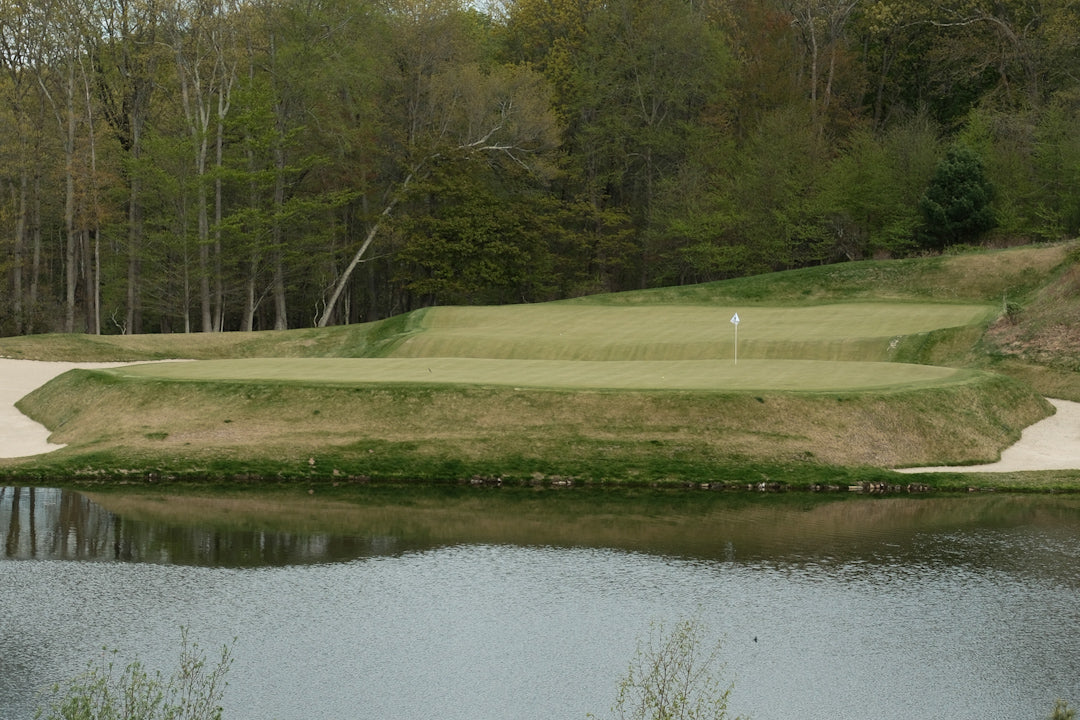
Opening Weekend at Yale
Scorer: David Lee
Opening weekend at Yale Golf Course marks the awakening of a sleeping giant.
Gil Hanse's two-year restoration returns Yale to its original ambition, but the sleeping giant has always had a complicated relationship with its own terrain. Set across 720 acres of rocky, hilly New Haven forest and built in 1926 by C. B. Macdonald and Seth Raynor, with the help of Charles Banks, using steam shovels and dynamite, the golf course at Yale was among the most ambitious and expensive undertakings of the Golden Age.
Over time, that difficulty compounded. Heavy soils, severe topography, and a dense tree canopy gradually constricted the design, softening bold contours and narrowing playing corridors. Hanse's restoration reverses that drift, reestablishing the course's original architectural intent on its centennial.
The same rocky, heaving landscape that complicates maintenance is also what gives the architecture its force. Yale is a course defined by physicality. The scale of the land, massive greens, the depth of hazards, and the volatility of movement are bold. Despite its severity, the routing holds together well across both nines.

Raynor and Banks laid out eight template holes across the unforgiving ground: Road, Short, Cape, Biarritz, Alps, Redan, Valley, and Eden. The difficult terrain requires adaptation of the templates, amplifying the uniqueness of the terrain and separating Yale's templates from lesser interpretations: on flat land, ideal holes can feel sterile or academic. At Yale, Fishers Island, Lookout Mountain, or even Old Macdonald, they feel wild and shaped by the land rather than imposed upon it.
The third hole, Blind, presents the restoration's most compelling argument and a heretical but defensible take: does Yale have two Alps holes? The rebuilt upper fairway re-introduces a second route, the recovered double punchbowl green restores lost character, and the blind approach plays with all the drama of its named cousin at the twelfth.
The Cape 8th is another strong hole, its widened fairway sharpening the risk-reward decision without diminishing consequence.
The set of par 3’s is elite, asking four distinct questions with no redundancy: The Short at five is now 90% surrounded by its bunker, which provides visual intimidation that is disproportionate to its length. On a course defined by scale, there are few places the golfer feels it more than on the Biarritz ninth, where the trench is as severe as advertised, the carry over water demands commitment, and pin position swerves the strategy day to day. The Redan at thirteen is subtle where the Biarritz is bold, rewarding correct lines with ground movement rather than drama. The Eden at fifteen is exacting and unforgiving of lazy pin reading.

The fourteenth, Knoll, is confusing at first as the landform to the left dominates the eye, and may sit higher than the green itself. Some debate which feature gives the hole its name, but the answer matters less than the result: a brilliant use of the land that keeps golfers thinking, and that most architects may have simply routed around.
And then there is eighteen. Visible from the entrance road as you drive in, jarring and confusing before you have reached the first tee, the closing 629-yard hole sends you over a hill, then either around, or over another hill. Wild, barely legible on first play, and completely unforgettable. By the time you walk off the eighteenth green, the questions the course posed on the first tee have been answered, loudly, and on its own terms.

At Yale Golf Course, the challenge rewards the ambition for the walking golfer and the architecture defining it. The boldness of the terrain that limits conditioning is also what elevates the architecture and its adaptation of ideal golf holes. Hanse has done his part. The greens are rebuilt, the corridors reopened, and the bones restored.
What happens next belongs to the superintendent and the seasons. Judged on architecture alone, Yale should be in the conversation for best public course in America. What course can match its combination of scale, variety, and the wild, adapted use of templates?

1 comment
Awesome rundown! Excited to get up and see it myself
Lee Gordon
Leave a comment
This site is protected by hCaptcha and the hCaptcha Privacy Policy and Terms of Service apply.